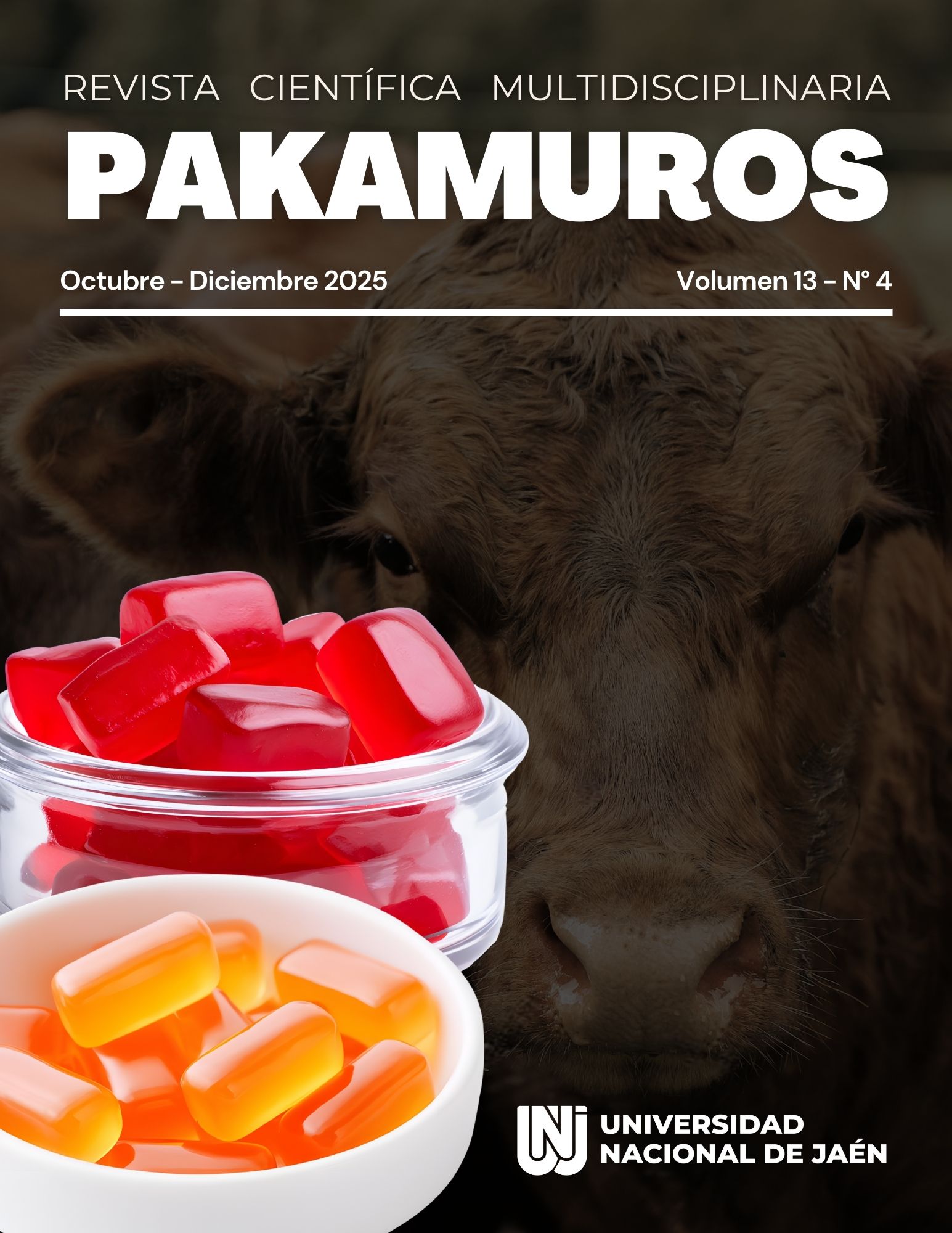
Bromatological, microbiological, and effectiveness evaluation of gummies fortified with vegetable extract and bovine blood meal
DOI:
https://doi.org/10.37787/nv3bvb52Keywords:
childhood anemia; , rural community; , iron deficiency; , functional food; , schoolingAbstract
Iron deficiency anemia in children remains a public health problem of concern, especially in rural areas of Peru. The objective of this study was to evaluate the bromatological, and microbiological composition and efficacy of gummies fortified with carrot extract (M1), beet extract (M2), and bovine blood meal. A sample of 20 school-age children from the district of Los Morochucos was divided into two groups, one for M1 and the other for M2. Both gummy formulations showed acceptable levels of moisture, potassium, iron, and nitrogen, low levels of copper, arsenic, and lead, and microbiological parameters indicated that the gummies were safe for human consumption. In terms of efficiency, M2 was better, increasing hemoglobin levels from 12.12 to 12.63 g/dL, which is attributed to the synergy that develops between iron and beet compounds that promote its absorption. In contrast, gummies fortified with carrot extract showed no significant changes, which could be associated with low compliance in accompanying gummy consumption with a citrus drink, which in turn influenced the bioavailability of iron. The results show that it is possible to include gummies fortified with vegetable extracts and bovine blood meal as part of the diet of school-age children who are vulnerable to anemia.
References
Alarcon, S. G. (2020). Iron-deficiency anaemia (IDA): Socio-cultural misconceptions intersect the health of vulnerable populations in developing countries [Tesis de licenciatura, Portland State University]. https://doi.org/10.15760/honors.859
Astuti, I., Munigar, M., & Lukman, E. (2019). The effect of the mixed juice of carrot and guava with iron supplement for adolescent with anemia. En Proceedings of the 5th International Conference on Health Sciences (ICHS 2018). https://doi.org/10.2991/ichs-18.2019.19
Athe, R., Rao, M. V. V., & Nair, K. M. (2014). Impact of iron-fortified foods on Hb concentration in children (<10 years): A systematic review and meta-analysis of randomized controlled trials. Public Health Nutrition, 17(3), 579–586. https://doi.org/10.1017/S1368980013000062
Ceclu, L., & Oana-Viorela, N. (2020). Red beetroot: Composition and health effects – A review. Journal of Nutrition, Medicine and Diet Care, 5(2), 1–9. https://doi.org/10.23937/2572-3278.1510043
Chiroque, R. G. S., Santiago, H. P. C., Espinoza, L. E., Quispe, L. A. M., Tirado, L. R. P., Villegas, L. M. N., & Villegas, M. A. N. (2023). A review of slaughterhouse blood and its compounds, processing and application in the formulation of novel non-meat products. Current Research in Nutrition and Food Science, 11(2). http://dx.doi.org/10.12944/CRNFSJ.11.2.06
Chouraqui, J. P. (2022). Dietary approaches to iron deficiency prevention in childhood—A critical public health issue. Nutrients, 14(8), 1604. https://doi.org/10.3390/nu14081604
Colegio Médico del Perú. (2023). Informe del seminario La anemia infantil en el Perú: situación y retos, una nueva perspectiva. https://www.cmp.org.pe/wp-content/uploads/2023/11/INFORME-DEL-SEMINARIO-LA-ANEMIA-INFANTIL-EN-EL-PERU.pdf
Díaz-Llocclla, M. (2023). Formulación y evaluación sensorial de gomitas fortificadas con harina de sangre bovina a partir de extracto de zanahoria (Daucus carota), remolacha (Beta vulgaris) y espinaca (Spinacia oleracea). AgroScience Research, 1(2), 63–70. https://agroscienceresearch.com/index.php/journal
Di Foggia, M., Tugnoli, V., Rombolà, A. D., & Lucena, J. J. (2020). Testing a bovine blood-derived compound as iron supply on Cucumis sativus L. Agronomy, 10(10), 1480. https://doi.org/10.3390/agronomy10101480
Di Rienzo, J. A. (2009). InfoStat versión 2009. Grupo InfoStat, FCA, Universidad Nacional de Córdoba. https://www.infostat.com.ar/
Espinosa, O. (2009). Desafíos para la inserción en el mercado por parte de familias campesinas y de pequeños productores de cereales en la provincia de Cangallo, Ayacucho [Informe]. https://cies.org.pe/wp-content/uploads/2016/07/pequenos-productores-campesinos-de-la-provincia-de-cangallo_2_0.pdf
Fernandez, M. V., Bengardino, M., Jagus, R. J., & Agüero, M. V. (2020). Enrichment and preservation of a vegetable smoothie with an antioxidant and antimicrobial extract obtained from beet by-products. LWT, 117, 108622. https://doi.org/10.1016/j.lwt.2019.108622
Gillooly, M., Bothwell, T. H., Torrance, J. D., MacPhail, A. P., Derman, D. P., Bezwoda, W. R., Mills, W., Charlton, R. W., & Mayet, F. (1983). The effects of organic acids, phytates and polyphenols on the absorption of iron from vegetables. British Journal of Nutrition, 49(3), 331–342. https://doi.org/10.1079/BJN19830042
Instituto Nacional de Estadística e Informática (INEI). (2018). Mapa de pobreza monetaria provincial y distrital 2018. https://www.inei.gob.pe/media/MenuRecursivo/publicaciones_digitales/Est/Lib1718/Libro.pdf
Instituto Nacional de Estadística e Informática (INEI). (2023). Consulta por encuesta: Encuesta Demográfica y de Salud Familiar – ENDES. https://proyectos.inei.gob.pe/microdatos/Consulta_por_Encuesta.asp
Lesjak, M., & Srai, S. K. S. (2019). Role of dietary flavonoids in iron homeostasis. Pharmaceuticals, 12(3), 119. https://doi.org/10.3390/ph12030119
Li, T., Deng, J., Liu, X., Duan, Q., Liu, H., & Xiong, S. (2021). DcCCD4 catalyzes the degradation of α-carotene and β-carotene to affect carotenoid accumulation and taproot color in carrot. The Plant Journal, 108(4), 1116–1130. https://doi.org/10.1111/tpj.15498
Ligarda-Samanez, C. A., Villano-Limache, E., Pichihua-Oscco, W., Choque-Quispe, D., Sucari-León, R., Calderón Huamaní, D. F., et al. (2025). Physicochemical and sensory evaluation of gummy candies fortified with microcapsules of guinea pig (Cavia porcellus) blood erythrocytes and tumbo (Passiflora tarminiana) juice. Applied Sciences, 15(2), 917. https://doi.org/10.3390/app15020917
Ministerio de Desarrollo e Inclusión Social (MIDIS). (2024). Reporte regional de indicadores sociales de Ayacucho. https://app.midis.gob.pe/redinforma/Upload/Mancomunidad/Ayacucho.pdf
Ministerio de Trabajo y Promoción del Empleo. (2022). Estudio de la dinámica económico-laboral actual y tendencia en Ayacucho. https://cdn.www.gob.pe/uploads/document/file/4042105/Diagn%C3%B3stico%20de%20Ayacucho.pdf
Ministerio de Salud (MINSA). (2024). Avances y retos del plan multisectorial para la prevención y reducción de la anemia materno infantil en el Perú, 2024–2030. Unidad Funcional de Alimentación y Nutrición Saludable, DGIESP – MINSA. https://intranet.mesadeconcertacion.org.pe/storage/documentos/2024-12-13/vf-avances-y-retos-del-plan-multisectorial-anemia-10122024-1-1.pdf
Nnam, N. M., Mbah, B. O., & Orisa, C. A. (2023). Anthropometric and biochemical indices of infants fed complementary foods developed from millets, orange-fleshed sweet potatoes, carrot, periwinkle and oyster meat flour blends. American Journal of Food Science and Nutrition, 5(2), 35–53. https://doi.org/10.47672/ajfsn.1664
Pillaca, S., & Villanueva, M. (2015). Evaluación de seguridad alimentaria y nutricional en familias del distrito de Los Morochucos en Ayacucho, Perú. Revista Peruana de Medicina Experimental y Salud Pública, 32(1), 73–79. https://doi.org/10.17843/rpmesp.2015.321.1577
Prosad, S., Jahan, F., Islam, B., Bashera, M. A., Hasan, M. D., Islam, M. J., et al. (2023). Nutritional characteristics and antiradical activity of turmeric (Curcuma longa L.), beetroot (Beta vulgaris L.), and carrot (Daucus carota L.) grown in Bangladesh. Heliyon, 9(11), e21495. https://doi.org/10.1016/j.heliyon.2023.e21495
Punia, S., Singh, A., Chaudhary, V., Sharma, N., & Lorenzo, J. M. (2023). Beetroot as a novel ingredient for its versatile food applications. Critical Reviews in Food Science and Nutrition, 63(26), 8403–8427. https://doi.org/10.1080/10408398.2022.2055529
Rahmani, S., Julaecha, J., Perwitasari, T., & Kusuma, R. (2025). Pemanfaatan pangan lokal untuk pencegahan anemia pada remaja putri di SMAS Adhyaksa 1 Kota Jambi. Jurnal Akademika Baiturrahim Jambi, 14(1), 113–125. https://doi.org/10.36565/jab.v14i1.926
Ramachandran, S., Manthena, R., Gopi, C., & Dhanaraju, M. D. (2024). Enhancement of non-heme iron absorption from vegetable foods by using vitamin-C supplements in Wistar rats. Research Journal of Pharmacy and Technology, 17(5), 2224–2228. https://doi.org/10.52711/0974-360X.2024.00350
Sabahi, S., Abbasi, A., & Mortazavi, S. A. (2024). Phenolic components from carrot (Daucus carota L.) pomace: Optimizing the extraction and assessing its potential antioxidant and antimicrobial activities. Heliyon, 10(17), e36971. https://doi.org/10.1016/j.heliyon.2024.e36971
Sari, M., Bloem, M. W., De Pee, S., Schultink, W. J., & Sastroamidjojo, S. (2001). Effect of iron-fortified candies on the iron status of children aged 4–6 y in East Jakarta, Indonesia. American Journal of Clinical Nutrition, 73(6), 1034–1039. https://doi.org/10.1093/ajcn/73.6.1034
Sumarlina, N., Rahayu, A., Sofa, I., Suhesti, L., Suryati, A., Danengsih, N., et al. (2024). Pumpkin jelly candy giving “Pororo gummy” (pumpkins and carrots to growth) to increase appetite in toddlers. International Journal of Engagement and Empowerment, 4(3), 365–372. https://doi.org/10.53067/ije2.v4i3.183
Sundararajan, S., & Rabe, H. (2021). Prevention of iron deficiency anemia in infants and toddlers. Pediatric Research, 89(1), 63–73. https://doi.org/10.1038/s41390-020-0907-5
Toft, U., Riis, N. L., & Jula, A. (2023). Potassium – a scoping review for Nordic Nutrition Recommendations 2023. Nordic Nutrition Recommendations, 68, 10365. https://doi.org/10.29219/fnr.v68.10365
UNICEF. (2021). Niñas, niños y adolescentes en el Perú. Análisis de su situación al 2020. Resumen ejecutivo. https://www.unicef.org/peru/media/12141/file/Resumen%20Ejecutivo:%20Situaci%C3%B3n%20de%20ni%C3%B1as,%20ni%C3%B1os%20y%20adolescentes%20en%20el%20Per%C3%BA%20.pdf
UNICEF. (2023). Large-scale food fortification for the prevention of micronutrient deficiencies in children, women and communities: Guidance note (1st ed.). https://www.unicef.org/media/151001/file/Large-scale%20food%20fortification%20for%20the%20prevention%20of%20micronutrient%20deficiencies%20in%20children,%20women%20and%20communities.pdf
Varshney, K., & Mishra, K. (2022). An analysis of health benefits of beetroot. International Journal of Innovative Research in Engineering and Management, 9(1), 207–210. https://doi.org/10.55524/ijirem.2022.9.1.39
World Health Organization (WHO). (2025). Anaemia. https://www.who.int/health-topics/anaemia#tab=tab_1
Xiao, Y., Yang, B., Ni, J., & Hu, R. (2024). Efficacy of an iron-fortified gummy on iron-deficiency anemia in young women. Functional Foods in Health and Disease, 14(2), 97–113. https://doi.org/10.31989/ffhd.v14i1.1239
Published
Data Availability Statement
Todos los datos pertenecientes a la investigación forman parte del manuscrito, en caso de requerir información adicional esta debe ser solicitada al autor de correspondencia vía correo electrónico.
Issue
Section
License
Copyright (c) 2026 Pakamuros Scientific Journal

This work is licensed under a Creative Commons Attribution-NonCommercial 4.0 International License.